
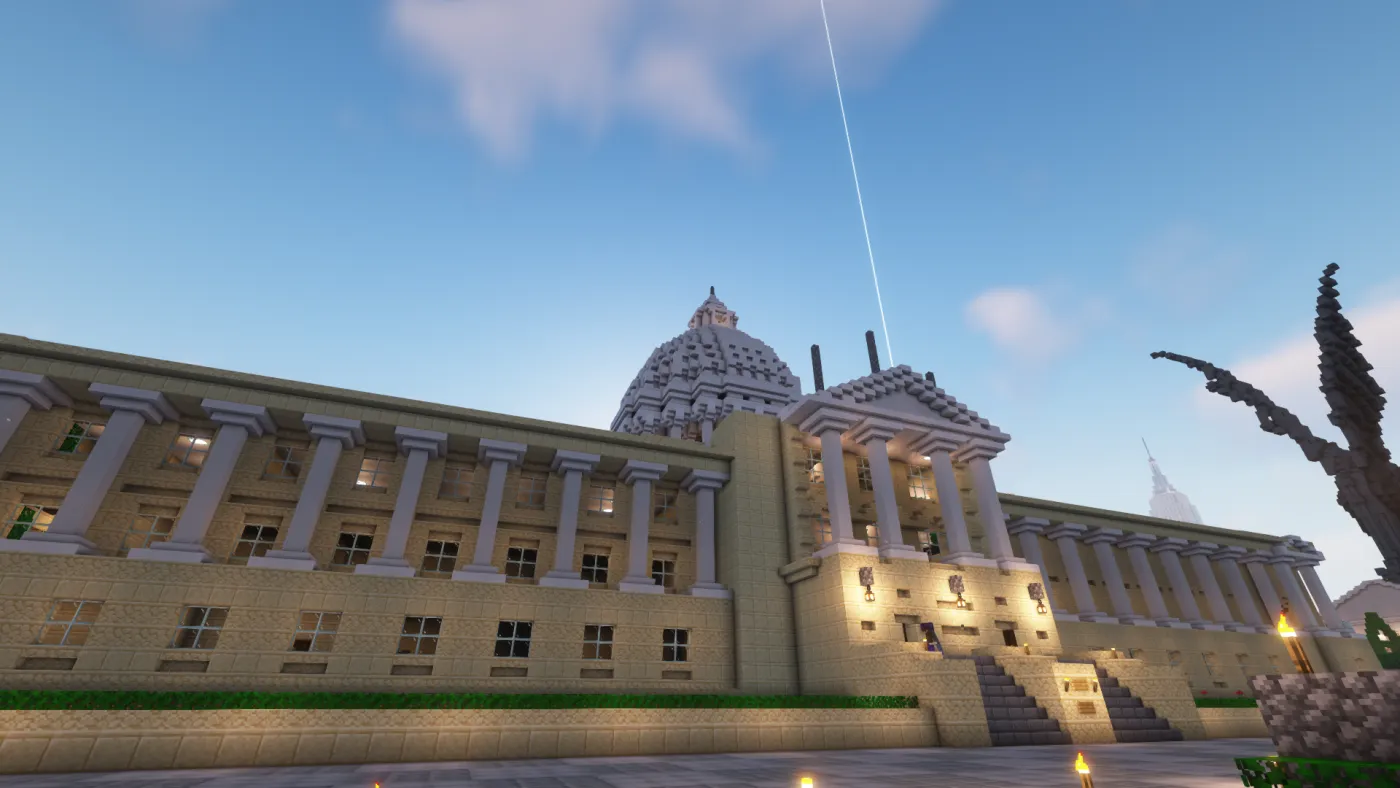
What New Philadelphia is
New Philadelphia is a self-governing city, founded in 2018. Its citizens build it, farm it, trade in it, keep it safe, and govern it.
The city is governed by its Charter, adopted on February 4, 2020. The Charter sets out what the city expects of its citizens and of its government. It establishes a City Congress to write the laws, courts to hear cases, and five departments to run the city day to day.
The city keeps its own currency, the New Philadelphian Dollar, issued as cash vouchers by the Department of Commerce.1
Everything the government writes is public, unless publishing it would endanger a person or an investigation.2
The city’s motto, Spectemur Agendo, means “Let us be judged by our acts.”3
How the city is governed
- Five departments run the city: Defense, Criminal Investigations, Commerce, Infrastructure, and Agriculture. Each is led by a department head.
- City Congress writes the city’s laws. Every elected officeholder serves in it as a legislator.4
- The courts hear the city’s cases. The Supreme Court sits in the Atrium Summi, where citizens may watch from the gallery, and other cases go to the New Philadelphia Courthouse.5
The Interim City Council
Under the PILLARS Act (C.A. 2025.01), the Interim City Council is the city’s executive. Its members are the five department heads. Together they hold every power the Charter gives the Governor, decide by vote, and meet at City Hall, 110 Essential Street.6
The Office of the Governor is suspended, and no election for Governor is held while the Act is in force. The Act took effect on November 4, 2025, for up to five years. Congress may extend it or end it early.7
History
The city’s record is kept by the Historical Society of the Department of Agriculture. These are the moments that shaped New Philadelphia.
The first settlers
New Philadelphia began, as many cities have, out of nothing. The first settlers arrived around August 2018 and spent their first night in a shelter cut into a mountain. Restored to how it is believed to have looked, it stands today as the First Night Museum on Essential Street, Downtown.
Another early settler found structures already standing near the north end of JFK Boulevard. Some of them have been preserved or recreated there.
The Revolution
The Revolution is the largest armed conflict in the city’s history. The city had no government yet, and not even a name. The largest business in the region was Grandma’s Cakes.
The conflict began when a formerly peaceful resident killed the Grandma’s Cakes mascot, then rallied a group against a “tyrannical ruler,” though no formal leadership existed. It ended when the people defeated the movement’s leader. He and his followers were exiled, and have since been allowed to return.
The names of those who fell are kept on the Revolution Memorial. The city remembers the Revolution as the darkest point in its history.
The Lawbook
After the Revolution, the people formed a government and wrote the New Philadelphia Lawbook, which held every law of the city. On the same day, the city was named and the first draft of its seal was made.
The government was formed so that every person in the city would be equally entitled to the same pursuits and standard of living. The Lawbook remains a reference to the city’s laws.
The Department of Criminal Investigations
The Department of Criminal Investigations is established. Today it oversees the city’s police, investigations, prosecution, and prisons.
The Charter
The city adopts the New Philadelphia Charter, first titled the Official Library of New Philadelphia Statutes. It sets out every expectation of citizens and government, and creates a fuller system of government to protect every part of the city.
The Historical Society counts this as the start of the city’s present era, and its most successful.
The New Philadelphian Dollar
The New Philadelphia Cash Voucher Report sets the value of the city’s currency.8
Term limits
Term limits for the city’s elected offices begin.9
The PILLARS Act and the city anthem
City Congress passes the PILLARS Act, which suspends the Office of the Governor in favor of an Interim City Council. Its purpose is to spread executive power more widely among the people while the city’s population is at its smallest. Governor TCraft777, who had led the city since 2018, signs it.
The same day, Congress approves the city’s anthem, “By Our Acts,” written and performed by the New Philadelphia Philharmonic.
The Interim City Council takes office
The PILLARS Act takes effect. The five department heads begin governing together as the Interim City Council.10
Sources
- 1.City Charter 6 §5
- 2.City Charter 1 §8
- 3.City Charter 1 §19
- 4.City Charter 3 §1
- 5.City Charter 4 §1
- 6.PILLARS Act (C.A. 2025.01) §30002
- 7.PILLARS Act (C.A. 2025.01) §20005
- 8.City Charter 6 §8
- 9.City Charter 10, Chapter 4
- 10.PILLARS Act (C.A. 2025.01) §10001